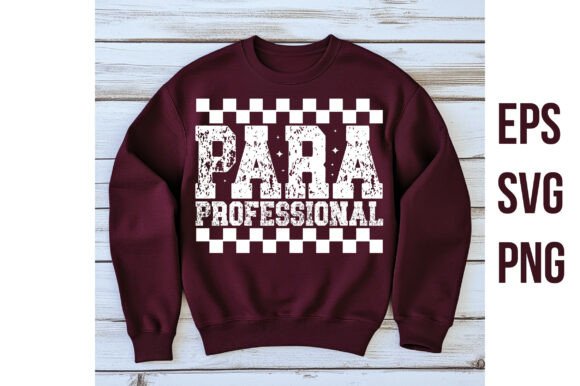
Para Professional SVG: Graphics for T-Shirt Designs
First Impressions: Clean, Versatile, and Ready for Commerce
Opening Para Professional SVG felt like unboxing a well-organized design kit—not flashy, but instantly usable. The visual tone is confident yet approachable: balanced weight, clear negative space, and intentional line work. It leans modern-professional rather than playful or ornate—think “small business branding” meets “handmade business credibility.” It’s not overly decorative, which means it scales cleanly across product types without competing with text or photography. For Etsy sellers building cohesive seasonal collections—or print-on-demand creators launching new t-shirt designs—it lands as trustworthy, not trendy.
Real-World Use Cases: From Mockups to Marketplaces
I tested Para Professional SVG across six product categories in my shop draft: t-shirt designs, mug mockups, Canva template headers, printable wall art (8×10 and 11×14), Cricut-ready sticker sheets, and sublimation-ready tote bag layouts. In every case, the graphic held up. As a t-shirt design, it printed crisply at chest and back placements—even on textured cotton blends. As a sublimation design, the clean vector paths translated smoothly into heat-transfer previews. For Canva templates, I dropped it into presentation slides and social media banners without needing to trace or simplify. And as a sticker design, the SVG cut cleanly on my Cricut Maker—no stray nodes or overlapping paths.
Where It Adds Immediate Value
- Product mockups: Looks sharp in lifestyle shots—especially against neutral backgrounds or minimalist apparel.
- Thumbnail appeal: Stands out in Etsy and Creative Fabrica grid views thanks to strong contrast and readable proportions.
- Digital download bundles: Pairs naturally with coordinating fonts (I used Montserrat for headings, Playfair Display for accents, and Caveat for subtle handwritten tags).
- Printable designs: The included PNG has true transparency—no halo or edge artifacts—and prints flawlessly at 300 DPI on matte and glossy stocks.
- Social media graphics: Works as a logo lockup, story highlight icon, or branded post divider without resizing distortion.
What’s Inside: Practical File Structure, Not Just Hype
The package delivers exactly what a working digital seller needs: one high-res PNG (transparent background, 300 DPI), one scalable SVG (clean layers, no embedded raster), and one EPS (for Adobe users needing legacy compatibility). All files are named consistently—para-professional-01.svg, para-professional-01.png, etc.—so organizing customer downloads or internal asset libraries is frictionless. No “bonus” filler files. No compressed ZIP confusion. Just three production-ready graphic design assets, each serving a distinct commercial purpose.
Smart Pairing & Presentation Tips
To maximize perceived value, I paired Para Professional SVG with complementary design assets: a muted color palette (sage, charcoal, cream), minimalist packaging mockups, and serif-based typography for product descriptions. On Etsy, I used it across listing images—not just as the main graphic, but as a subtle watermark on secondary photos and as a consistent header in PDF instructions. That repetition built visual hierarchy and reinforced brand identity across listings. For Shopify, I added it to email footers and blog post dividers—low-lift ways to reinforce recognition without overexposure.
Where to Proceed With Caution
This isn’t a one-size-fits-all clipart solution. Avoid using it as tiny planner stickers (under 0.5 inches)—fine details blur at small scale. Skip dense scrapbooking kits where it might compete with patterned papers or layered elements. Don’t force it onto dark backgrounds without checking contrast first—the base black version lacks midtone depth, so test with a soft gray overlay if needed. And while the SVG cuts cleanly on Cricut, avoid complex weeding scenarios: it’s optimized for single-layer vinyl, not multi-color layered decals.
Testing Checklist Before Publishing
- Preview the PNG on both white and charcoal mockups—does it retain legibility?
- Open the SVG in Cricut Design Space and run a quick “Make It” test—verify cut lines align and there are no hidden compound paths.
- Drop the design into a Canva template at 100%, 75%, and 50% size—check for pixelation or jagged edges.
- Print a physical sample on your target paper stock—confirm no halos, bleed, or registration drift.
- Upload the PNG thumbnail to your marketplace dashboard and view it at 120px width—is the core shape still recognizable?
- Review the commercial license: confirm you’re cleared to sell finished products (e.g., mugs, shirts) and digital derivatives (e.g., Canva templates, sticker sheets).
Final Verdict: A Reliable Workhorse, Not a Gimmick
Para Professional SVG won’t go viral—but it will convert. It’s the kind of digital product that quietly lifts your shop’s professionalism: consistent, licensable, technically sound, and commercially flexible. It fits seamlessly into print-on-demand workflows, supports scalable digital download bundles, and reinforces small business branding without demanding attention. If you’re curating a collection of T-Shirt Designs or building a library of versatile Graphics, this isn’t the flashiest pick—but it’s the one most likely to earn repeat use, positive reviews, and cross-sell potential. Test it early in your workflow. Use it where clarity matters more than charisma. And always pair it with intentional presentation—it’s a tool, not a magic wand.